
How to Flip Houses in Sydney | Real Estate Guide NSW 2025/2026
 Fact checked


Home improvement TV shows like The Block, Love It or List It, and The Aussie Property Flippers make for great viewing. They can also trigger an “Eureka!” moment in your mind. Maybe you saw a couple of house flippers make half a million dollars in the space of a couple of months, and it's made you think, “I could do that.”
Well, the truth is, you absolutely can.
According to Cotality, property owners in the Bayside region made an average gross profit of $593,865. Those who renovated and sold units in Woollahra made, on average, $284,833. Both of these stats are based on flipping homes within four years of purchasing them.
However, it is important not to get carried away by these figures. House flipping is hard work, filled with setbacks and hurdles. To be successful, you have to have the finances in place and be able to manage the risk.
At DiJones, we’ve had hundreds of ambitious property owners come to us for help with flipping homes. Our expert advice? Prepare, plan, and then prepare a bit more.
Are you up for the challenge? We’re happy to help. You can contact our knowledgeable team at any time. In the meantime, we’ve compiled a guide to help you get started. Let’s get into it.
Key takeaways
- When planned and executed well, flipping houses in Sydney can generate good profit. But it's not without its risks.
- The house flipping process from property purchase to resale can take between three and six months.
- Experienced home flippers target a 10–20% net profit margin after accounting for all costs.
- To complete a typical Sydney flip, you may need as much as $135,000 or more in available capital.
- Kitchens, bathrooms, and curb appeal renovations deliver the highest ROI.
What is house flipping?
House flipping is a real estate strategy that involves buying, renovating, and selling property within a short timeframe. The goal is to make as big a profit margin as possible by minimising costs and maximising the resale value of your home.
If you get it right, house flipping is a profitable investment. But you need to weigh up risk versus reward before you commit to doing so. Key success factors include being able to:
- Accurately assess market conditions
- Keep renovation costs low
- Understand buyer expectations in your suburb
- Make quick, non-emotional decisions
According to DiJones Real Estate Agent Piers van Hamburg “Over the past 20 years, my wife and I have personally flipped 8 homes on Sydney’s Lower North Shore. The key to doing this successfully is buying well in the first place, making sensible and appealing improvements, prioritising location, and choosing the right moment to sell. A strong understanding of market trends and deep local knowledge is essential, it’s what ensures you get the strategy right and ultimately maximise your return.”
Related: Where is the best place to buy an investment property?
The rewards and risks of house flipping
Sixteen per cent of homes listed in Australia have been owned for less than three years. This represents a 15-year high, due in part to the popularity of flipping houses.
Undoubtedly, flipping homes in Sydney can offer an attractive ROI. However, it does come with significant financial and time commitments. That’s why it is important to weigh up the risks and rewards before diving in. Here are a few things to consider.
The rewards
- Quick (and potentially big) profits: House flipping can be a great way to generate a quick and lucrative profit.
- Skill-building: Flipping houses will build your skills and give you real estate investing experience.
- Satisfaction: Flipping homes is one of the most rewarding things you can experience.
The risks
- Loss on your Investment: You might struggle to sell your property for as much as you’d hoped for; you might even make a loss if the market dips.
- Costs: There has been a 31% increase in residential building costs in the last five years. This can impact your potential ROI.
- Competition: Flipping properties is popular. So, you might struggle to find the right property if there are lots of other ambitious buyers in your local market.
Is house flipping the right move for me?
Flipping houses can be rewarding, but it’s not suited to every investor or homeowner. You need the right qualities if you want to do it right and increase your chances of turning a profit. Here are four we consider essential.
Money
Flipping houses in Sydney can be expensive. This is primarily because it involves significant upfront and holding costs. Therefore, it is worth knowing how much money is needed to start flipping houses in your chosen suburb.
Beyond the initial purchase price, you’ll need funds for stamp duty, renovation expenses, council approvals, and selling costs. You’ll also need to have a good financial cushion to cover unexpected costs.
As a general guide, buying a home for $400,000 and trying to flip it for $550,00 may require you to have as much as $135,000 in available capital. This would cover the costs of buying, running, and improving a property. However, this figure depends on several factors – how much renovation you intend to do, the suburb you are in, and how quickly you flip and sell the home.
The amount of cash you have available can determine both the scale of your project and your ability to handle unexpected expenses. Here are some costs to consider when flipping a home:
Legal fees for buying and selling
- Stamp duty
- Mortgage (during the length of the flip)
- Property valuation fees (when buying)
- Building and pest inspection (when buying)
- Lender’s mortgage insurance (if your deposit is less than 20%)
- Renovation costs
- Selling agent’s advertising and commission
- Loan exit fees and charges (if applicable)
- Rates
Related: Understanding capital gains tax on investment properties
Renovation skills
Renovation costs often take up a large part of a house flipping budget. If you have skills in this area, it will save you time and money.
That said, it is important to be honest with yourself. If a specific skill is beyond your abilities, factor in the extra cost of hiring a contractor before you purchase the property.
Take the time to find a good one. If you intend to flip as your full-time gig, you’ll need to rely on a team of trusted tradespeople or design partners. They will help you achieve a professional finish in a quick timeframe that appeals to prospective buyers.
Market knowledge
When flipping a home, it is not essential to have extensive knowledge of the Sydney property market. However, knowing the local real estate market can help you to maximise your ROI.
The best way to gain insights is to talk to your local DiJones agent. We have a deep understanding of the current real estate trends and nuances in your suburb.
Time
TV shows might make you think houses can be flipped in a matter of a couple of months. However, the reality is that house flipping takes time and patience.
It’s important to consider whether you have the room to commit to the project. If you’re already working a full-time job and have other responsibilities on top of that, you may decide flipping isn’t viable right now.
However, if you are ready to commit, creating a realistic timeline is essential. Underestimating the time it takes to flip a home can impact your profitability and stress levels.
How long does it take to flip a house?
So, how long does it take to flip a house in Sydney?
From the initial purchase to the flipped sale handover, the typical house flipping timeline is between one and six months. However, this can vary depending on factors like the extent of renovations, your work speed, and any buyer conditions.
Here is a typical timeline for flipping a house in Sydney:
- First month: Property search, inspections, and legal due diligence.
- Second month: Settle the purchase and finalise renovation plans.
- Third and fourth months: Complete renovation works.
- Fifth month: Styling, photography, and listing for sale.
- Sixth month: Open homes, sale, and settlement
Which renovations add the most value when flipping?
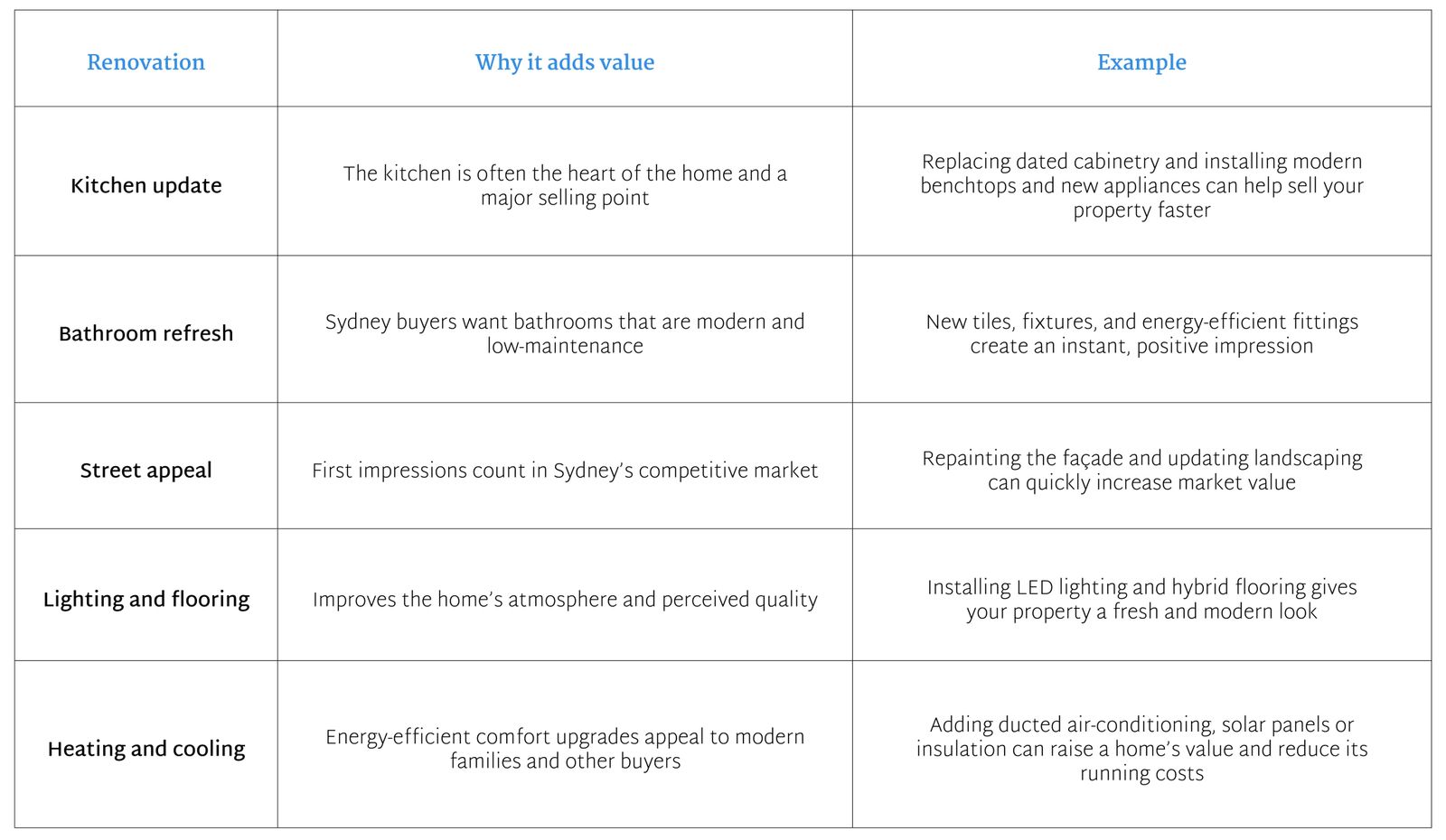
Some property market experts believe that a cosmetic renovation of between $30,000 and $50,000 can increase a property’s value by as much as $150,000.
So, which renovations will add the most value in a home? Broadly speaking, the answer is any upgrade that will improve the functionality, energy efficiency, and overall presentation of a property.
Indeed, there are some strategic improvements you can make that will help to maximise resale value while keeping costs under control. Here is an overview of the best areas to target and why it is important to do so.
How much profit can you make flipping houses in Sydney?
If you want to make money through flipping houses, you’ll need to get a handle on profit margins. This measures how much you earn after covering all your buying, renovation, holding, and selling costs. It is usually expressed as a percentage of the property’s final sale price.
Why do you need to know this? It makes it easier to calculate potential returns and manage risk.
Most experienced investors aim for a 10–20% net profit margin. However, this can vary depending on property prices, market trends, the suburb your property is in and the scale of your renovation. Before committing to a purchase, it is essential to balance your estimated costs against your expected resale value.
Here is an example:
- A flipper purchases an older two-bedroom unit in Marrickville for $850,000.
- Their renovation and holding costs total $120,000. This brings the total investment to $970,000.
- After modernising the kitchen, bathroom, and flooring, the property sells for $1.15 million.
- The net profit on this sale is worked out as follows: $1,150,000 − $970,000 = $180,000
- Therefore, the profit Margin is calculated: ($180,000 ÷ $1,150,000) × 100 = 15.6%
This example demonstrates how a well-planned renovation, in a strong local market, could help you achieve a healthy flipping profit.
What is the 70% rule in house flipping?
The 70% rule is a guideline investors use to avoid overpaying for a property they want to flip. It advocates spending no more than 70% of the property’s after-repair value (ARV) minus renovation costs.
Doing this helps ensure there’s a sufficient buffer for unexpected expenses. It also keeps you on track to make a profit and ensure the project remains financially viable.
For example, suppose a renovated property’s after-repair value (ARV) is estimated at $900,000. If the renovation costs are expected to be $100,000, the 70% rule suggests:
- 70% of $900,000 = $630,000
- $630,000 − $100,000 = $530,000
In this scenario, a home flipper should aim to pay no more than $530,000 for the property.
Tips for every stage of the house-flipping process
If you are ready to commit to house flipping, there are three stages to the process. Let’s take a look at each and explain what you need to know.
The acquisition stage
First things first. You need to find a house to flip. That might sound like the easiest part, but a lot goes into finding the right one.
The most important things are to do your research and to plan carefully. Here are four things to consider.
1. Choose carefully
Pick properties in the right housing market that are within your budget. As tempting as it might be, don’t go over it.
2. Understand the area
Assess the ceiling cost of properties in your area. This is the maximum amount of money houses have sold for.
Suppose you must sell a property for half a million to make a profit. If no home in the area has ever sold for that much, you’re taking on a lot of unnecessary risk.
3. Inspect the house
Don’t commit to buying anything until you’ve had the chance to weigh up the job at hand.
Inspect every element of a potential property. Ensure it’s structurally sound and doesn’t have any foundation issues. Make an honest assessment that the work required is manageable within your time constraints.
4. Plan before you buy
Factor expected costs into your budget before you sign any dotted lines. Consider the contractors you’ll need to hire and where you can find them.
Plan for any home renovations and make sure you have a contingency fund for unexpected costs.
The renovation stage
Once the property is in the bag and you’ve paid the deposit, you can start renovating. Here are four things to keep in mind.
1. Build a contractor network
Draw up a long list of reliable contractors you can call upon when required. The last thing you need is to face a situation where you have a serious plumbing fault and are rushing around to find someone to fix it.
2. Design first
Work with a design professional to survey the land and plan out the overall layout of the structure before you commit to any repairs. Create a blueprint for what you want to achieve.
3. Prioritise
Always start with the essentials first. Think of foundational problems and utilities. These are the core tasks that will take most of your time.
Nobody wants to lay down a fresh coat of paint only to find they then need to rip apart a wall to tackle an electrical fault.
4. Put the buyer first
Consider what the buyer will be looking for throughout the process. This means thinking with practicality, functionality, and style.
Try not to let personal ideas get in the way of your end goal. Make sure all of your decisions will benefit the buyer. Doing this will help your property sell faster.
The marketing and sales stage
Once the house is renovated, a lot of the hard work is done. However, you still need to market and sell the home. Here’s some advice on how to do that.
1. Stage the home
A professional can help you stage the space so it looks attractive to potential buyers. They will know how to get the best out of your house. This can help the home sell faster and can even help you make more money on the sale.
2. Consider property tax
You’re liable for capital gains tax (CGT) when you flip a house in Australia. However, there may be ways you can avoid it if you are selling an investment property.
The amount you pay depends on your profit and how long you owned the property before selling. It is worth seeking advice from a qualified accountant to understand the full tax implications of flipping a home.
3. Work with a real estate agent
Marketing the property and arranging viewings are two tasks best left to experts. Work with a real estate agent who can emphasise the benefits of your property and help to get it off the market.
4. Close the deal with a solicitor
Hire the right solicitor to handle the negotiation stage with buyers. They will ensure all your paperwork is in order and will read through the buyer’s paperwork to make sure all the details are correct.
Related: A guide to buying property in NSW
The best locations for house flipping in Sydney
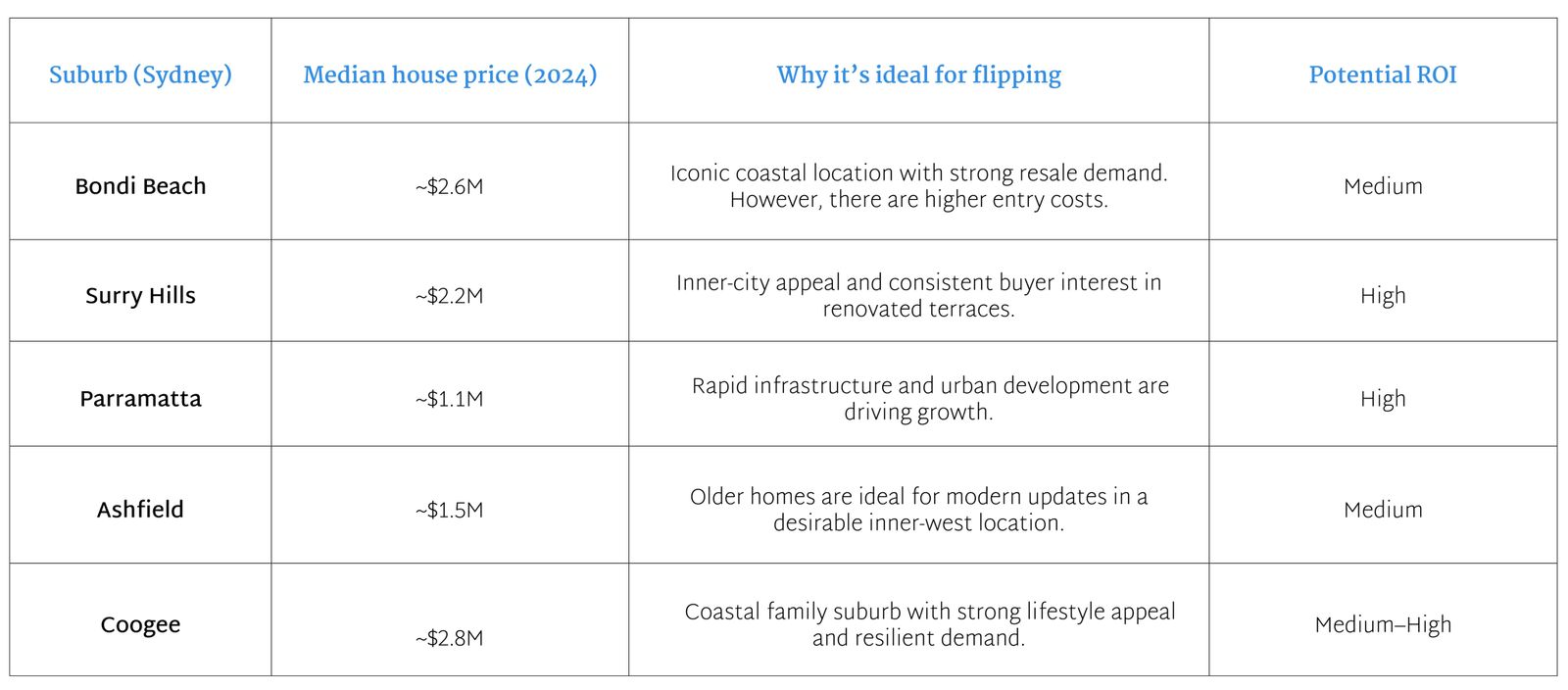
Location is very important when determining the best suburbs for house flipping in Sydney. To establish which one is right for you, here are some things to consider:
- Strong and growing market: Suburbs showing steady capital growth and low vacancy rates.
- High buyer demand: Areas with consistent turnover and short days on market.
- Desirable amenities: Proximity to transport, schools, and cafés can help attract prospective buyers.
- High-impact renovation potential: Older housing stock that benefits from cosmetic or structural improvements.
- Affordable entry point: Lower buying costs can widen your potential profit margin.
As for specific suburbs, here is a brief overview of some of the best locations in Sydney where you can flip a property right now.
How do I start flipping houses?
For the beginner, the process of flipping houses can appear quite daunting. Here are five steps you can take to flip a Sydney property successfully.
- Understand your local market, renovation costs, and current buyer trends. Review data to identify growth suburbs.
- Speak with a lender or financial advisor, such as Shore Financial, to determine how much you can borrow and manage your holding costs.
- Engage trusted professionals, such as agents, builders, and stylists who can help sell your finished property.Find and acquire the right property. In particular, look for homes that need cosmetic upgrades in high-demand areas. If this is an investment property, you may be able to use your superannuation or equity from your existing home.
- Renovate within budget. Then engage a high-performing local real estate agent to market strategically and achieve a strong resale result.
The bottom line
Contrary to what you might see on TV, successful property flipping is never easy. In fact, if anything, it’s often the opposite. However, the better you plan and prepare, the more likely you are to be successful.
Budget properly. Have everything in place before you begin. Be mindful that setbacks are just part of the game.
When all is said and done, you should be able to make a good profit when flipping a Sydney home or unit. All it takes is the right strategy, a good network, and plenty of sound and non-emotional decision-making.
How DiJones can help you
DiJones has supported Australia’s property owners and property buyers since 1992. We’ve seen the triumphs and the turbulence that come with flipping. That’s why we want to help every ambitious Australian do it right the first time.
Want some extra support? Contact us today to find out how we can help you get a bigger return on investment as you start flipping properties. We’ll be more than happy to help.
FAQs
Do you need a licence to flip houses in Australia?
At present, you do not need a specific license to flip houses in Australia. However, you may legally be required to hold a relevant license or permit if you intend to do electrical, plumbing, or structural renovation work yourself.
In addition, it’s possible the ATO might consider your house flipping to be a business activity. Therefore, it's worth familiarising yourself with potential implications related to Capital Gains Tax (CGT), GST, and Workplace Health and Safety.
What’s the best property type to flip?
The best properties to flip are the ones that provide as high a return on investment (ROI) as possible in the shortest time span.
Typically, they tend to be structurally sound but cosmetically outdated. They are often located in growth suburbs with high buyer demand but priced below the suburb median.
It helps if they have a layout flexibility that allows you to add a bedroom or bathroom. However, steer clear of homes with major structural or compliance issues.
How much money do you need to flip a house in Australia?
This is a difficult question to answer because the amount you need will vary depending on the following factors:
- The age and style of the property
- The suburb where the property is located
- The extent of the renovation work you want to perform
- Who is your preferred buyer
- Legal fees (buying and selling)
By providing expert advice on the local property market, the DiJones team can help you create a realistic budget.
Can you flip a house while living in it?
In theory, it is possible to renovate and sell a property that you are living in to reduce your holding and rental costs. However, this is not considered a ‘flip’ in the traditional sense. A house flip involves buying a property specifically to renovate and resell it for a profit.
Living in a property while flipping it may slow down your renovation timescale. It also won’t exempt you from having to pay capital gains tax.
What is the 70% rule in house flipping?
The 70% rule helps investors avoid overpaying for a property. It suggests outlying no more than 70% of the home’s after-repair value (ARV) minus renovation costs.
This buffer accounts for holding costs, selling expenses, and unexpected repairs. It also still maintains a healthy profit margin.
What are the risks and challenges of house flipping?
House flipping carries several risks for Sydney property owners. This includes rising construction costs, project delays, and fluctuating property prices.
Overcapitalising can reduce your profit margins. Additionally, unexpected repairs, extended holding periods, and slower market conditions can impact your ability to achieve a successful resale.
Disclaimer
DiJones Real Estate, together with their directors, officers, employees and agents have used their best endeavours to ensure the information passed on in this document is accurate. However, you must make your own enquiries in relation to the information contained in this document and seek advice from your financial advisor, broker or accountant to ascertain its application to your circumstances.
This information is provided subject to our Terms and Conditions.
Was this content helpful to you?