The ultimate guide to staging your house for sale
 Fact checked


When preparing to sell your home, the way you present it makes all the difference. Home staging is a way of making your home look as attractive as possible to prospective buyers. If done well, it can influence how quickly someone puts in an offer for it.
Staging your home will help you get your property sold faster.
According to DiJone Real Estate Agent - Lucie Trinco "Staging isn’t about decorating for style. It’s about creating a space that helps buyers instantly picture themselves at home. That emotional connection can be the difference between a property sitting on the market for months and one that attracts strong offers quickly."
It might sound daunting, but staging your home is actually pretty simple if you know what to do. And we should know. We’ve helped homeowners navigate the Sydney property market for more than 32 years. Beautiful staging has always been a big part of the process.
Follow these steps. Run through our top tips. Plan carefully. Do all of that? You might just get your home sold faster and for more money. Let’s dive in.
Key questions answered
How much does it cost to stage a house? In Sydney, the cost of professional staging usually ranges from $2,000 to $8,000.
Do staged homes sell faster? Industry research shows that staged homes sell faster and often spend fewer days on the market than unstaged properties.
What are the most important areas to stage in a house? The living room, master bedroom, and dining room are the most important rooms to stage in your home.
Do you have any DIY home staging tips? To stage a house for sale, follow this process: Declutter, deep clean, arrange furniture, style with décor, maximise light, and maintain the exterior (also known as curb appeal).
How does staging a house help sell my property faster?
Staging your house means styling and decorating your property to give the right first impression when people view your home.
Home staging is about no one but the buyer. Namely, it is about making sure the buyer can envision themselves living comfortably in your property. As such, the goal is to make the home look flattering, functional, and even better than it appeared in the photos.
Your buyer isn’t looking for a mere property. They are looking for a home that they feel emotionally attached to. They want to be invested. They are looking for a property they can move into now. Property staging creates that connection. It makes it more likely a buyer will look at your property and say: ‘This is the one. Where do we sign?’
However, staging isn’t just for show. It makes it more likely you’ll sell the home quicker, which will save you money. How long your property is on the market will impact your home’s value. The value decreases the longer your home takes to sell.
According to a recent Australian study, 49% of staged homes are sold in the first week. This figure increases to 66% in two weeks and 87% in four.
When buyers inspect your home, they typically form an opinion about it within minutes of walking through the door. Therefore, the way it is presented can strongly influence that reaction. Plus, it makes it more likely that buyers will pay a higher selling price to make sure they get the home for themselves.
How much does professional staging cost for Sydney homes?
This is a reasonable question. If you’re looking at staging a home orinvestment property, the exact cost will depend on a number of factors, including the size, style, and location of your property, the condition it’s in, and the length of time you want to stage it for.
While every property is unique, here’s a general guide to follow:
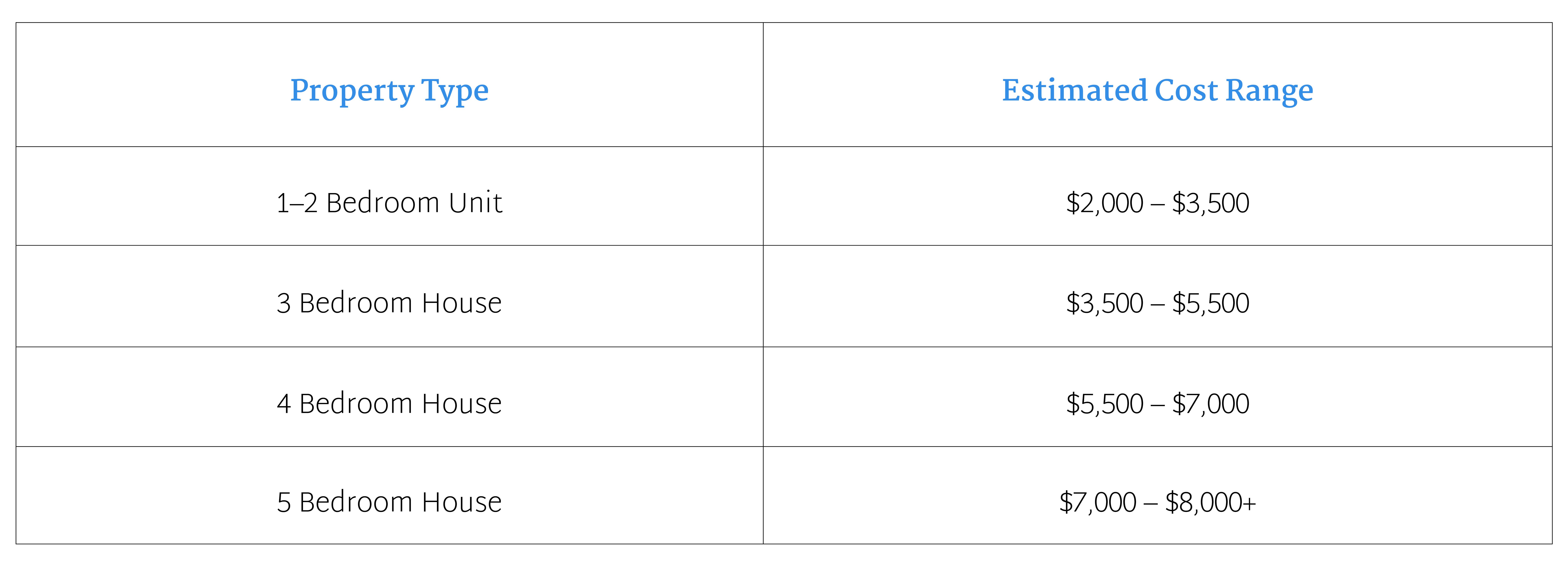
These figures typically include furniture hire, styling, delivery, and professional services.
Industry research supports that professional staging is a worthwhile exercise. Some experts believe it can add as much as between 7.5% and 12.5% to the value of a home.
In addition, buyers' agents say that staging a home increased the dollar value offered between one and five per cent, compared to other similar homes on the market that were not staged.
Home staging is an investment. Spending the money now to stage your home is always cheaper than losing money to a depreciating market value. You’ll sell your property faster. You’ll also often sell it for more money than you initially anticipated, mainly because you’re helping the buyer form a connection with the property.
However, if professional staging is not in your budget, there are DIY home staging tips that can help.
Doing it yourself vs. hiring a professional
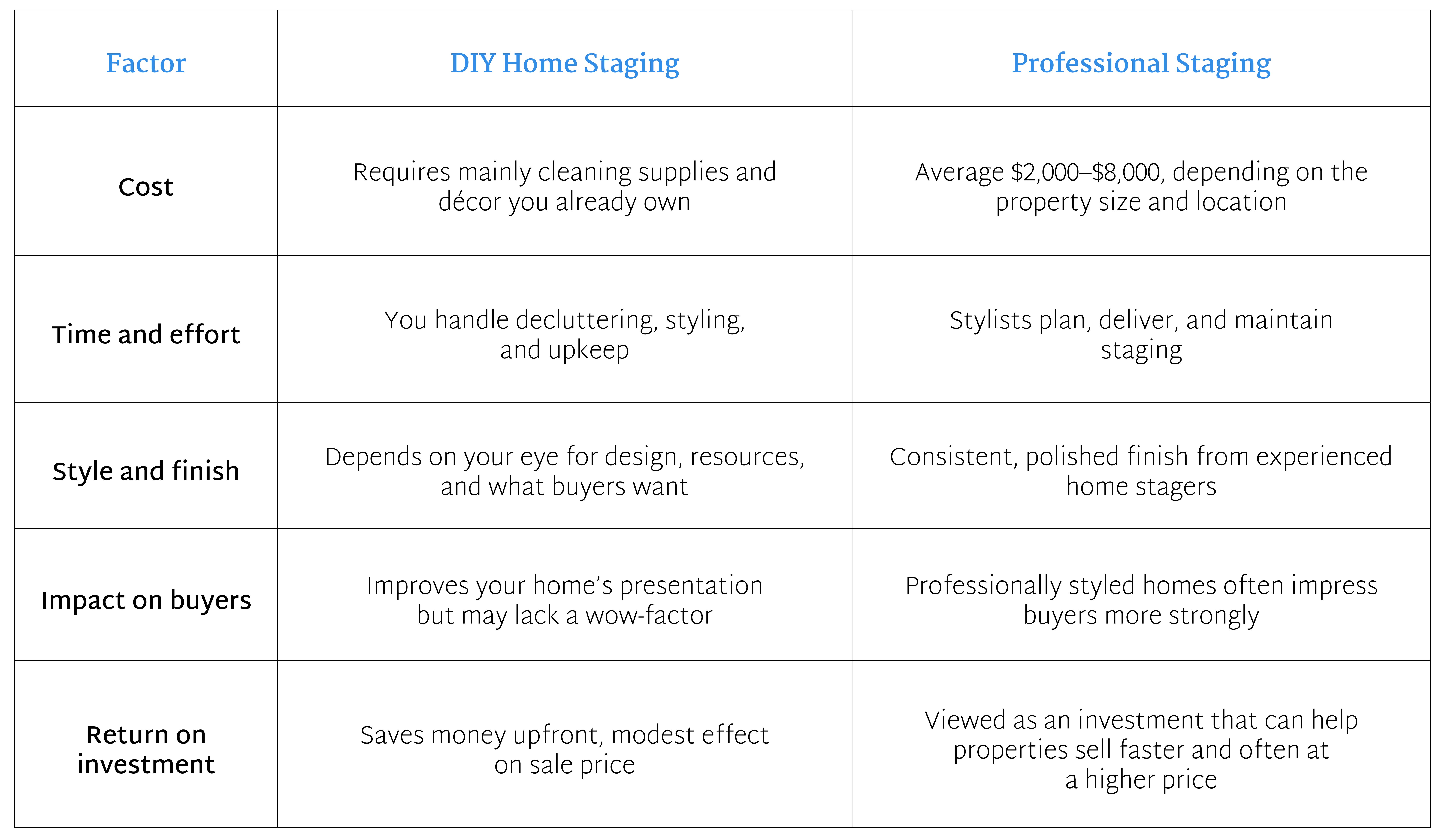
When preparing your Sydney home for sale, you’ll need to ask yourself – should you hire property stylists? Or should you roll up your sleeves and do it yourself?
Our advice in most cases is to hire a professional home staging company. (At least for the essential parts like styling and décor.)
A design team will style your home with the goal of maximising its saleability and value. They have years of experience doing this in the Sydney market. They know what works within a space and what buyers want. They can also implement ideas you perhaps hadn’t considered.
Alternatively, DIY home staging can be an attractive option for some homeowners, primarily because of its cost-effectiveness. You’ll have full control of the process, and you’ll also have the satisfaction of knowing you are presenting the property exactly how you want to. (Of course, there is no guarantee buyers will like what you’ve chosen to do.)
So – which option is right for you? Let’s break it down.
How do I stage a house for sale? Follow our step-by-step guide
When done well, a staged home highlights its main features and strengths. At the same time, it minimises distractions and creates an atmosphere where potential buyers can imagine themselves living within it.
Here are seven steps you can take to present your home in the best light possible.
1. Clear the clutter and remove personal items
Decluttering your house is an easy and proven way to make your home look more appealing.
Store away any memorabilia or personal items. Family photos. Books. Board games. Nick-nacks. Novelty fridge magnets from your holiday in Europe. Put them away temporarily.
This makes your home feel more spacious. It is also a process known as depersonalisation. You want your buyers to imagine themselves living in your home. You don’t want them to feel like they’re walking into someone else’s.
Depersonalising your space will help your buyer form that all-important emotional connection, which will make them more inclined to buy the property.
Bonus tip: It’s worth renting a short-term storage unit for your possessions. This makes it easier to declutter and depersonalise.
2. Deep clean and refresh surfaces
Once you’ve decluttered and depersonalised your home, you now have the perfect opportunity to deep clean it.
A spotless home shows that it has been loved and well looked after. Be sure to clean it from top to bottom and floor to ceiling to make it look brand new.
It is advisable to also wash windows, steam carpets, polish timber floors, and regrout bathrooms if needed. You may also want to repaint walls in neutral paint colours that appeal to the widest audience. Fresh paint always photographs beautifully for online listings.
You can also add some additional potted plants and space them out throughout the property.
Bonus tip: Use fresh flowers or scented candles to rid your home of any odours rather than overpowering air fresheners.
3. Arrange furniture for better flow and function
The way your furniture is positioned can change a buyer’s perception of how big or small your living spaces feel. Too much furniture can make rooms feel cramped; not enough furniture and they feel empty.
Each room needs to flow well and be easy to move around in. To ensure this, create clear pathways so buyers can walk through them easily.
It is also a good idea to arrange seating in conversational clusters in living rooms to show functionality. In bedrooms, place the bed where it feels most natural and central.
The key is to make each room feel like it has a single purpose. Striking the right balance between comfort and good flow will help buyers to see how each room works.
Bonus tip: Angle furniture slightly rather than pushing it flat against the walls. This small trick creates a sense of depth and space.
4. Style with simple décor and finishing touches
Décor is a difficult balancing act to achieve when staging a home. On one hand, you want to make your property look as inviting as possible. On the other hand, it can put buyers off if you lean too heavily into a specific theme or colour palette.
It is a good idea to opt for neutral colours like whites, creams, greys, beiges and taupes. A pop of colour is never a bad idea, but limit it to artwork, accent pillows, or even plants.
Remember: You’re trying to cast as wide a net and appeal to as many buyers as possible. Play it safe.
Bonus tip: Greenery (in the form of fresh plants or flowers) adds warmth and vitality to any home.
5. Make the most of light
Lighting is an often underutilised aspect of staging a home. However, it’s essential. It makes rooms look bigger. It also makes your property look more welcoming.
In addition, good lighting has a direct effect on a person’s mood. Buyers instinctively look more favourably on properties that have plenty of light flowing through.
The best part about great lighting is that it’s so easy—no money required to get started there. Make sure every curtain is open when you’re hosting viewings. Turn on all the lights, including any in closets and utility rooms. You may even want to consider having skylights or bigger windows put in.
Bonus tip: Mirrors are a godsend because they reflect light brilliantly and diffuse it into every dark corner that your window can’t reach. They also make your space look bigger. Don’t have many mirrors? Invest in a few cheap ones; it’ll make all the difference.
6. Don’t neglect the exterior and curb appeal
When a potential buyer drives up to your home, the first thing they see is its exterior. Often, they can form an opinion about your property even before they step inside.
Having a tidy, attractive exterior will instantly impress buyers. This can set the tone for the rest of the viewing. If you have a front garden, be sure to make it as presentable as possible.
Mowing the lawn, trimming hedges, cleaning pathways, and even repainting the front door and windowsills will create great curb appeal.
Bonus tip: Powerwashing the outside walls of your home can significantly lift its appearance.
7. Highlight key lifestyle features
The modern Sydney buyer is motivated more by lifestyle than mere bricks and mortar. They are most interested in the home’s main features and unique selling points.
For instance:
If you have a fireplace, style it with clean lines and minimal accessories.
Showcase built-in storage by leaving cupboards partly empty. This will suggest it offers generous space.
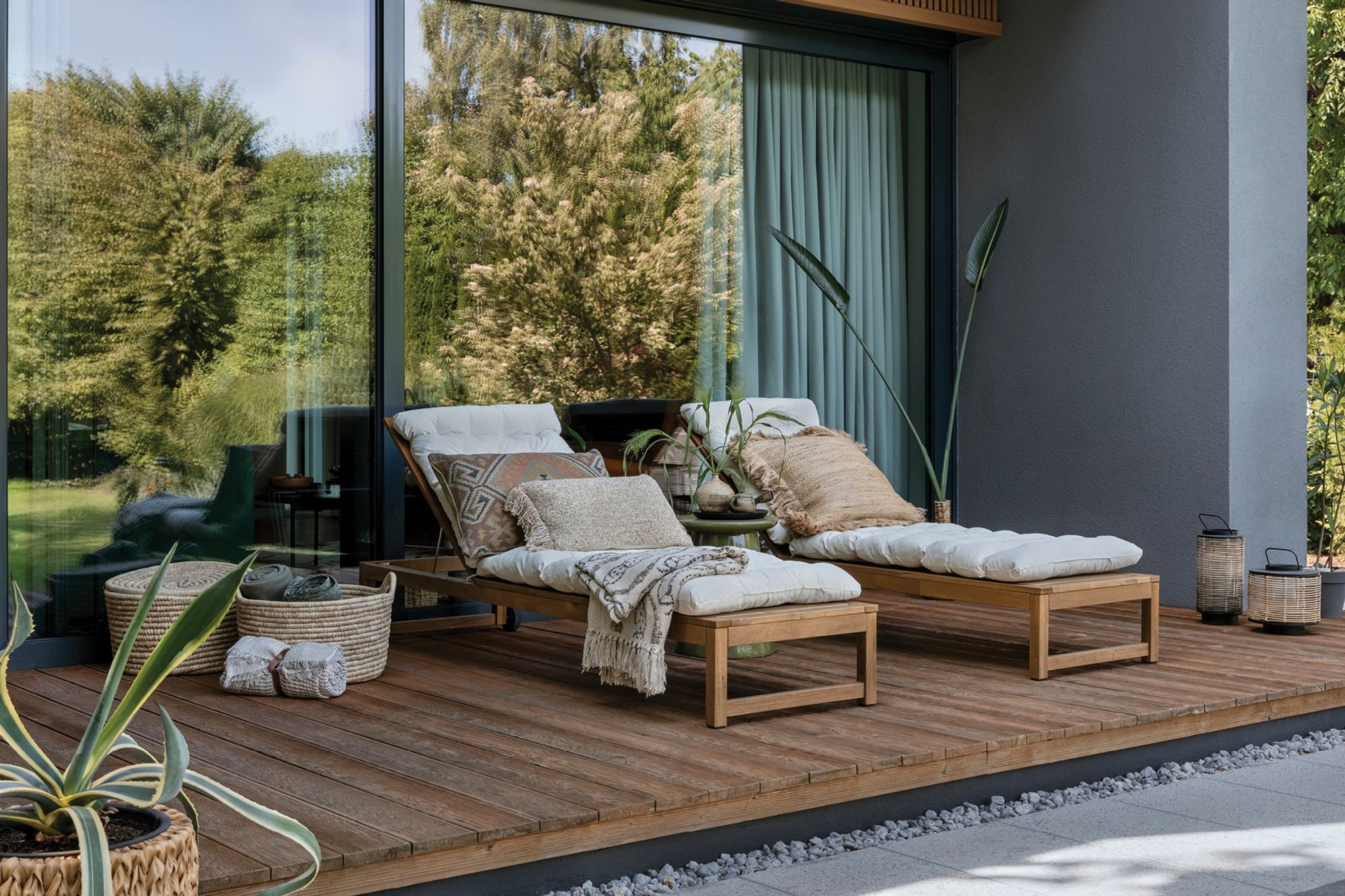
Stage outdoor entertaining areas with seating or a table to demonstrate their potential as living spaces.
By doing this, buyers are more likely to view your home as a functional, comfortable, and enjoyable place to live.
Bonus tip: Visit a few open houses in your suburb to see what features your competition has. Then present them in a more appealing way.
More budget DIY home staging tips
If you don’t have the budget to hire a professional, it is possible to make a strong impression with DIY home staging.
The seven steps outlined above still apply. The key is to focus on simple changes that maximise space and light and aren’t too expensive.
For more budget-friendly home staging tips, check out our article on how to prepare your home for sale.
What are the best rooms to stage when selling a house?
When it comes to staging, not every room carries the same level of significance in a buyer’s mind.
Here at DiJones we find that the most important areas to stage in a house are the living room, primary bedroom, and dining room. These are the spaces where buyers imagine themselves living their daily lives and entertaining family and friends.
A living room sets the tone and often creates the strongest emotional connection among buyers.
The primary bedroom provides a calm retreat where buyers can picture themselves resting and relaxing.
Dining rooms highlight family time, lifestyle, and entertainment potential.
Kitchens and outdoor spaces also influence a buyer’s overall impression of your home.
Is home staging worth the investment?
There is no doubt that staging or styling your home can help you sell it more quickly. If you do it well, you can also achieve a higher listing price.
While it might sound like a lot of work, house staging is easily manageable. The key is to know what you want to do and how you’ll do it. And if you get stuck, there is no harm in calling in the professionals.
How DiJones can help
Since our launch in 1992, we’ve helped hundreds of Australian home sellers get on and off the property market. With our knowledge of property styling and property management, you'll be on your way to a sale in no time.
Check out our buying and selling guides that offer helpful information and guidance for selling real estate, assisting you throughout the selling process.
Looking to request an appraisal or need further help? Connect with us today! Our expert team is always on hand to provide support.
FAQs
How much does professional home staging cost?
For Sydney homes, the cost of professional staging typically ranges from $2,000 to $8,000. However, this figure depends on several factors, including the size of your home, its location, the number of rooms that need to be styled, and the length of the campaign.
Do staged homes sell faster?
Industry research shows that staged homes sell faster and often attract more interest than properties that are unstaged. While staging doesn’t guarantee results, presentation can help increase buyer competition. This can lead you to receive quicker offers.
What are the best rooms to stage when selling?
When selling a home, the most common rooms to stage are the living room, master bedroom, and dining room. They tend to create the strongest lifestyle impressions for buyers. That said, kitchens and outdoor areas are also influential.
Is DIY home staging effective?
If you focus on decluttering, cleaning, and using neutral décor, DIY staging can be effective. While it provides a budget-friendly way to present your home, it may not have the same polish as a professional service would provide you with.
Is home staging worth the investment?
Yes. For many sellers, the benefits of staging far outweigh the costs of doing so. That is because it gives their homes a better presentation, which attracts potential buyers and better offers.
Was this content helpful to you?